For premium tobacco enthusiasts across the globe, acquiring a carton of “Chunghwa” (中华) is more than just a purchase—it is an investment in a world-class sensory experience. Known universally as the “National Cigarette” of China, Chunghwa is celebrated for its complex, mellow profile and its legendary signature “plum aroma” . However, the very essential oils and natural sugars that create this iconic fragrance are notoriously volatile.
Whether you are a collector in a bustling metropolitan hub or a remote coastal town, your biggest enemy isn’t the passage of time; it is the environment. From the bone-dry air of high-altitude regions to the sweltering humidity of tropical climates,
Before mastering the “how,” we must understand the “why.” Chunghwa cigarettes are a masterpiece of flue-cured tobacco. Unlike the “American Blend” or mixed-type cigarettes (like Marlboro) common in many Western markets, flue-cured tobacco relies heavily on high natural sugar content and delicate fermentation oils.
The famous plum scent is not a synthetic additive sprayed onto the paper; it is the result of a precise aging process involving aromatic compounds like p-methoxybenzaldehyde. When these cigarettes are exposed to improper conditions, the chemical integrity of the leaf fails:
The Humidity Trap: Because flue-cured tobacco is high in sugar, it is naturally hygroscopic (it pulls moisture from the air). In high-humidity environments, the tobacco becomes a breeding ground for fungi, leading to mold and “yellow spotting.”
The Evaporation Crisis: In dry environments, the essential oils evaporate. Once the tobacco reaches a “bone-dry” state, the cellular structure of the leaf becomes brittle. Even if you try to re-humidify the pack later, that signature plum aroma is often lost forever, replaced by a bitter, hay-like flavor.
What is the “Golden Zone” for Temperature and Humidity?
To maintain the peak integrity of your collection, you must ignore general household “room temperature” and aim for the “Golden Zone.” While tobacco can survive in a wider range, the following specifications are what professional collectors and tobacco scientists recommend to preserve tobacco freshness.
1. The Temperature Sweet Spot
The ideal temperature for storing Chunghwa cigarettes is between 18°C and 22°C (64°F to 72°F).
The Science of Heat: Temperatures above 25°C (77°F) accelerate the breakdown of organic compounds. Heat also acts as a catalyst for tobacco beetles; if microscopic eggs are present in the leaf, heat will cause them to hatch, ruining your entire carton.
Consistency Matters: Rapid fluctuations are worse than slightly higher static temperatures. If your storage area swings between 15°C at night and 28°C during the day, the tobacco will expand and contract, tearing the delicate cigarette paper and loosening the filter seal.
2. The Humidity Standard (60% – 68%)
While casual smokers often suggest 50%, professional consensus for premium flue-cured cigarettes suggests a Relative Humidity (RH) of 60% to 68%.
The 62% Rule: Most experts recommend a constant 62% RH for long-term storage. This provides enough moisture to keep the leaves supple and the oils intact without crossing into the “danger zone” of 70%+, where mold spores begin to thrive.
Internal Moisture Content: The goal is to keep the internal moisture of the tobacco strands at approximately 13% to 15%. If it drops below 10%, the cigarette will burn too hot, creating a harsh “throat hit” that masks the plum flavor.
Using a Cigar Humidor for Cigarettes: The Professional Choice
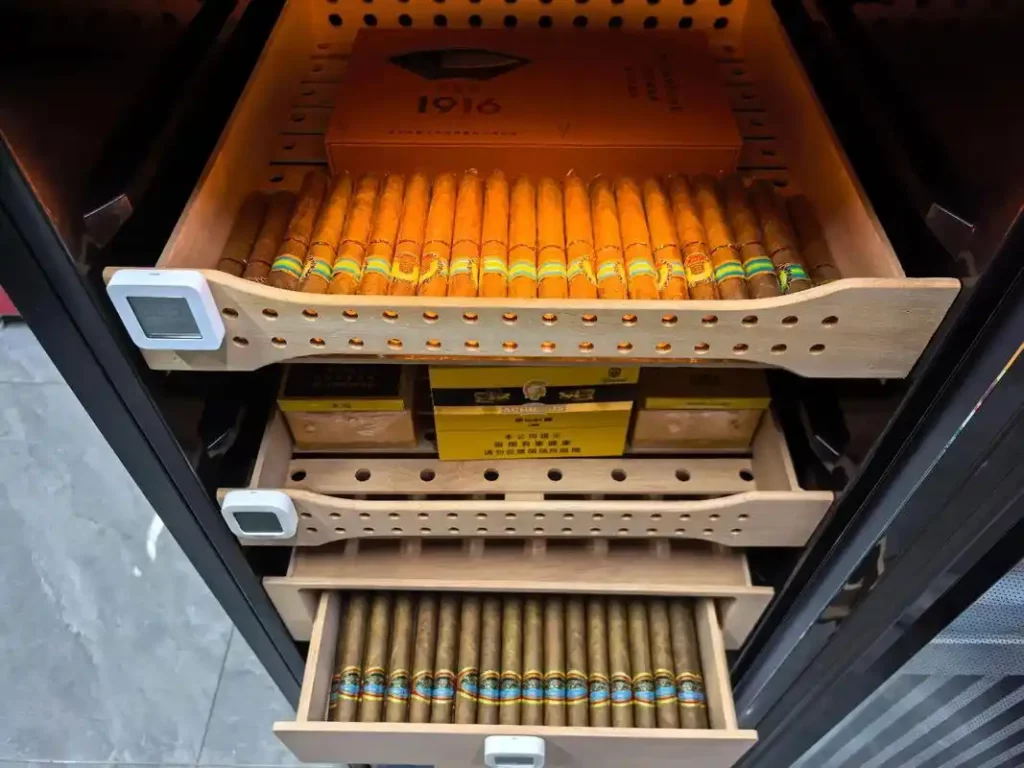
One of the most frequent questions from premium collectors is: “Can I put my Chunghwa cartons in my cigar humidor?” The answer is a resounding yes, provided you make specific adjustments. Using a cigar humidor for cigarettes is the gold standard for long-term preservation.
Why the Humidor is Superior
Spanish Cedar Lining: High-quality humidors are lined with Spanish Cedar, which naturally regulates moisture and acts as a deterrent for pests. It also adds a subtle woody depth that complements the flue-cured aroma.
Two-Way Humidity Control: Modern collectors use Boveda packs. For Chunghwa, using a Boveda 62% or 65% pack is the most reliable “set it and forget it” method. These packs add or remove moisture as needed to maintain a precise level.
Airtight Micro-climate: A humidor protects the cigarettes from the “micro-drafts” of your home’s HVAC system, which can strip moisture from a pack even if the room feels humid.
How to Organize Your Cigarette Humidor
Dedicated Storage: Tobacco is highly porous. Never store your Chunghwa cigarettes in the same humidor as pungent, oily Maduro cigars. Your cigarettes will eventually absorb the cigar scent, destroying the plum profile.
Carton Integrity: For storage longer than 6 months, keep the carton in its original plastic wrap. For immediate consumption (within 1-3 months), you can remove the plastic to let the tobacco “breathe” and interact with the cedar.
Horizontal Placement: Store the packs horizontally. Vertical storage can cause the tobacco to settle toward the filter or the tip over time, leading to an uneven burn.
The Refrigerator Method: A “Last Resort” Emergency Tool
In many Asian households, the “fridge method” is a common piece of folk wisdom. However, modern tobacco science generally advises against it. It should be treated as an emergency protocol only—used during extreme heatwaves if you lack a humidor.
Why the Fridge is Risky
Dehydration: Refrigerators are designed to remove moisture. Unless perfectly sealed, your cigarettes will be bone-dry within days.
Odor Absorption: Tobacco is an “odor sponge.” A Chunghwa cigarette stored near leftovers will absorb those scents.
The Condensation Killer: This is the biggest risk. When you take a cold pack out of the fridge, moisture from the warm room air condenses on the cold tobacco and paper. This creates instant soggy spots and promotes immediate mold growth inside the filter.
Emergency Protocol Steps
If you have no other choice but to use the fridge:
Triple Seal: Place the carton in a heavy-duty vacuum bag or an airtight glass container with a rubber gasket.
The “Slow Thaw”: Never open the container immediately after removing it from the fridge. Let it sit at room temperature for at least 3 to 5 hours until the container reaches ambient temperature. This prevents internal condensation.
Regional Storage Advice for International Users
If you are an expat or a collector in the West, your strategy must adapt to your local geography.
1. The Dry West (NV, AZ, CA, UT, High Altitudes)
In regions where RH often drops below 30%, your cigarettes will become brittle and lose their “plum aroma” rapidly.
The Fix: You cannot rely on open-air storage. An airtight container or a cigar humidor for cigarettes with a 62% Boveda pack is mandatory. If you use a simple plastic box, ensure it has a high-quality rubber seal.
2. The Humid South and Coastlines (FL, GA, UK, SE Asia)
Here, the air is too wet, making the tobacco “soggy.”
The Fix: Your focus is on dehumidification. Keep your collection in an air-conditioned room. If the room isn’t climate-controlled, use silica gel packets inside a sealed box, but monitor them closely with a digital hygrometer to ensure the RH doesn’t drop below 60%.
Even with the best cigarette storage tips, you should inspect your collection every 3 months. Look for these “Red Flags”:
The “Snap” Test: Take one cigarette and gently bend it. If it snaps immediately with a sharp sound, it is too dry. If it bends slightly and feels “springy,” it is perfect.
Yellow/Brown Foxing: Small circular yellow spots on the white paper (not from the tobacco oils bleeding through) indicate early-stage mold.
Scent Degradation: If the bright, acidic plum scent is replaced by a “dusty” or “musty” smell, the aromatic oils have oxidized.
Loose Fill: If tobacco flakes fall out of the ends easily, the leaves have shrunken due to low moisture.
FAQ: Frequently Asked Questions about Chunghwa Storage
How long can Chunghwa cigarettes last if stored properly?
If kept in a dedicated humidor at 62% RH and 20°C, a sealed carton can maintain its peak flavor for 1 to 2 years. While they can technically “last” for 5+ years, the volatile oils will eventually fade, even under perfect conditions.
Should I store my cigarettes in the basement?
Only if the basement is finished and climate-controlled. Unfinished basements are often too damp and have a high risk of “earthy” odors that tobacco will absorb.
Is it okay to use a damp sponge for humidity?
It is not recommended. A sponge releases moisture inconsistently and can easily lead to “over-humidification” (above 70%), which causes mold. Boveda packs are a much safer investment.
Summary of Professional Standards
Storage Factor
The “Golden Zone”
Equipment Needed
Ideal Temperature
18°C – 22°C (64°F – 72°F)
Indoor AC / Cool Dark Closet
Ideal Humidity
60% – 68% RH (62% is best)
Digital Hygrometer / 62% Boveda
Best Container
Dedicated Humidor
Wood or Acrylic Humidor
Avoid At All Costs
Direct Sunlight / Open Fridge
High Heat (>25°C)
Storing your Chunghwa collection properly is an act of respect for the craftsmanship that goes into every pack. By moving away from “fridge myths” and embracing professional cigarette storage tips, you can ensure that every time you light up, you are greeted with that unmistakable, premium plum aroma—no matter where in the world you are.